

Blastocyst culture is a crucial step in assisted reproductive technology (ART) where embryos are cultured in the lab for up to five days before implantation. This technique allows embryologists to assess embryos at a more advanced stage, called the blastocyst stage, to choose the highest-quality ones for transfer. The Blastocyst Culture Test involves careful monitoring and evaluation to identify embryos with optimal developmental potential. This method improves the chances of selecting viable embryos, enhancing the success rates of fertility treatments like in vitro fertilization (IVF). The extended culture period enables embryologists to observe natural progression and select embryos with the best chances of implantation, improving overall treatment effectiveness.
Blastocyst culture is an advanced technique used in the process of in vitro fertilization (IVF) to optimize the selection and transfer of embryos for a higher chance of successful implantation.
After retrieving eggs from the woman and collecting sperm from the man, they are combined in a controlled environment, typically a lab dish. Fertilization takes place, and the embryonic development begins.
Instead of transferring the embryos into the uterus after a couple of days, as in traditional IVF, the embryos are cultured for an extended period, usually up to five days. During this time, embryologists closely monitor their growth and development.
By day five, successful embryos reach the blastocyst stage. At this point, the embryo has developed into a more complex structure with two distinct cell types – the inner cell mass, which becomes the fetus, and the outer cell mass, which forms the placenta.
Extended culture allows embryologists to assess the quality of embryos more accurately. The ones that have developed into healthy blastocysts are considered more robust and have a higher likelihood of implanting successfully.
The best-quality blastocysts are carefully selected for transfer. This selection is based on criteria such as cell number, size, and symmetry, as well as the appearance of the inner cell mass and the blastocoel (fluid-filled cavity).
The selected blastocysts are delicately transferred into the woman’s uterus. This is a minimally invasive procedure that is often performed without the need for anesthesia.
After an egg is fertilized, it transforms into an embryo through various stages. This development typically follows a timeline:
The evaluation of blastocyst quality involves examining its external appearance. The blastocyst has two main parts—the trophectoderm, forming the placenta, and the inner cell mass, which becomes the baby. Grading blastocysts is not an exact science, and a high grade doesn’t guarantee pregnancy. However, top-quality embryos that reach the blastocyst stage by day 5 or 6 are more likely to have better chances of successful implantation.

Blastocyst culture holds significant importance in the field of assisted reproductive technology, especially in in vitro fertilization (IVF).
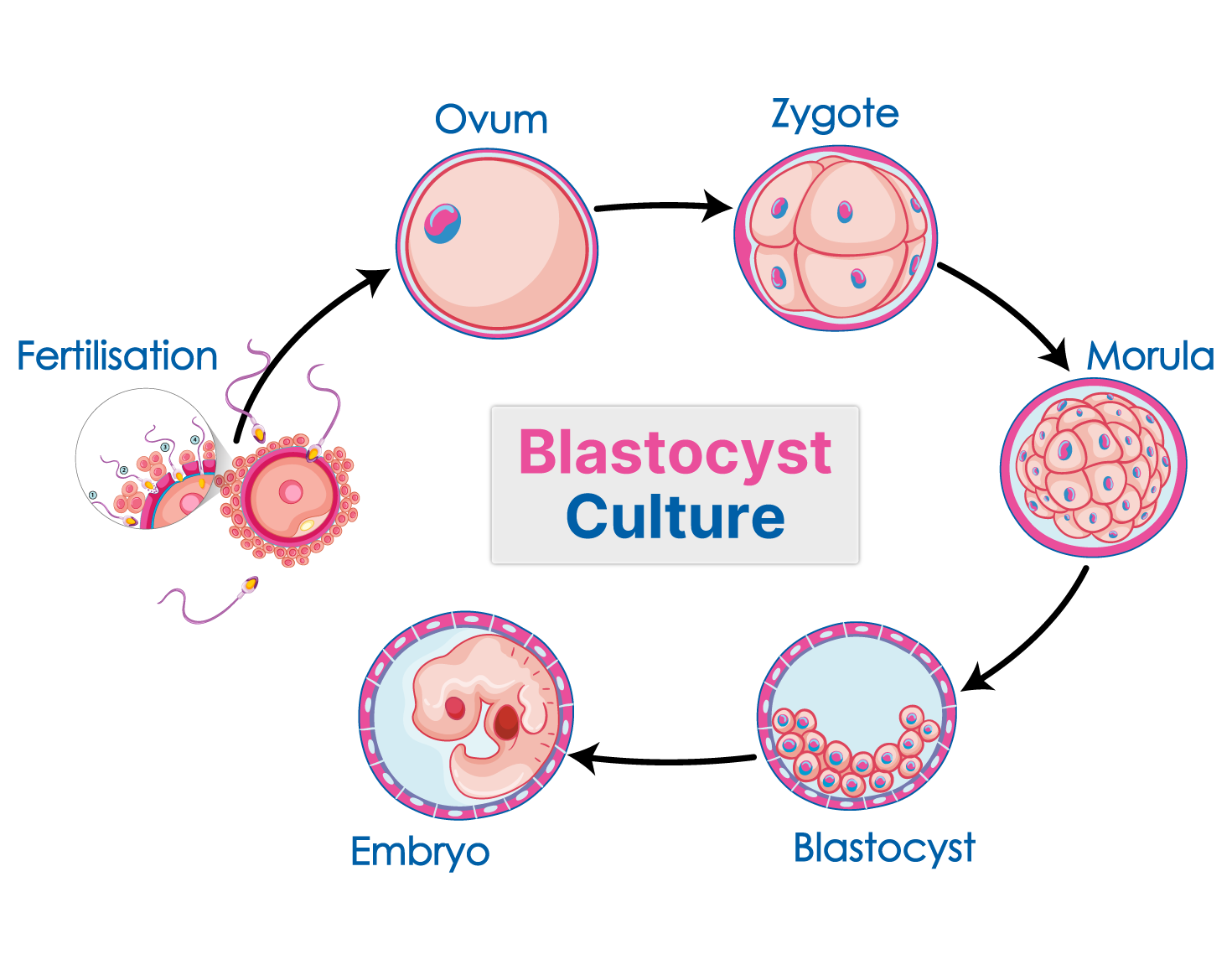
Blastocyst culture has changed how we do IVF treatments, making embryo selection more effective and precise. By letting embryos grow to the blastocyst stage before transferring them, embryologists can pinpoint the healthiest embryos with better chances of successfully implanting and leading to a pregnancy. Blastocyst culture comes with advantages like improved embryo selection, higher rates of implantation, and a lower risk of having multiple pregnancies. This technique has greatly boosted the success rates of IVF treatments, offering new hope for those seeking assisted reproductive options. Talking to fertility specialists and considering blastocyst culture can help create well-informed and personalized treatment plans, getting individuals closer to achieving their dream of becoming parents.

Blastocyst culture is a method in IVF where embryos grow in the lab for five to six days until they reach the blastocyst stage.
Blastocyst culture helps choose embryos with better development potential, improving pregnancy rates and lowering the chance of having multiple pregnancies.
Not all embryos will reach the blastocyst stage. Embryo development varies, and some may not go beyond the cleavage stage.
No, it doesn’t guarantee success. It boosts the chances, but factors like embryo quality and individual health also matter.
Blastocyst culture is safe, but not all embryos may reach the blastocyst stage, and there’s a small chance of having no suitable embryos for transfer after culture. Talking to fertility specialists is crucial for personalized information and guidance on blastocyst culture based on individual situations.
Book your consultation with our fertility experts the first step toward your parenthood journey.

